
Test Series for JEE Droppers/Repeaters: A Different Strategy for a...
Read More

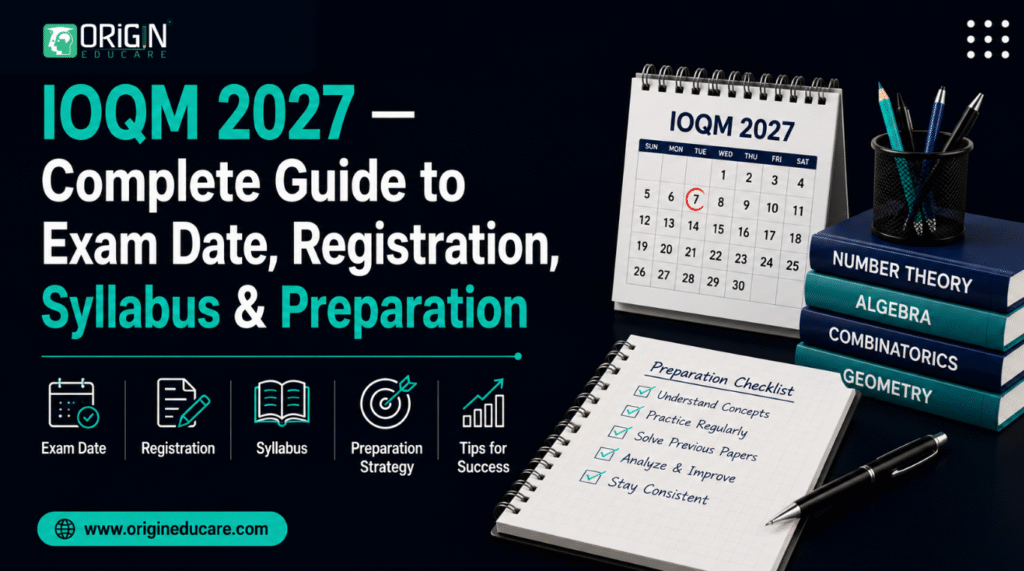
The IOQM 2026-27 exam was held on 6 September 2026.
If you appeared for it, results will be out soon. If you did not, or if you are planning, this guide is for IOQM 2027-28.
IOQM 2027 is expected in September 2027. Registration will open approximately in June 2027. You have around 10 months to prepare starting now.
This is the complete official guide: exam date, registration process, eligibility, syllabus, exam pattern, and a structured preparation plan.
IOQM stands for Indian Olympiad Qualifier in Mathematics.
It is the first stage of India’s official Mathematical Olympiad selection program — conducted jointly by MTAI (Mathematics Teachers’ Association of India) and HBCSE (Homi Bhabha Centre for Science Education).
Clearing IOQM makes you eligible for:
IOQM is open to students from Class 8 to Class 12. It is the starting point for students who want to represent India in international Mathematics competitions.
Based on the consistent pattern of previous years IOQM 2026-27 dates and trends — here are the expected IOQM 2027-28 dates:
Event | Expected Date |
Official Notification | June 2027 |
Centre Registration Opens | June 2027 |
Student Registration Opens | June 2027 |
Last Date to Register | July 2027 |
Admit Card Release | August 2027 |
IOQM 2027 Exam Date | September 2027 (first or second Sunday) |
Result Declaration | October 2027 |
RMO 2027 | November 2027 |
INMO 2028 | January 2028 |
Official dates will be announced on ioqm.mtai.org.in and hbcse.tifr.res.in. Always verify from the official portal before registering.
To appear for IOQM 2027-28, students must meet all of the following conditions:
Class Eligibility: Students currently studying in Class 8, 9, 10, 11, or 12 in any recognised school are eligible.
Age Criteria: Students must be born between 1 August 2008 and 31 July 2015 (expected based on 2026-27 criteria). The exact dates will be confirmed in the official 2027-28 notification.
Board: All school boards are eligible: CBSE, ICSE, State Boards, and Open Schools.
Other Conditions
IOQM registration can be done in two ways.
Through a Registered Centre (Recommended): Most students register through their school or a registered coaching centre. The centre coordinator handles the registration form and fee submission. This is the most common and reliable method.
Direct Individual Registration: Students can also register individually through the official IOQM portal. Individual registration requires uploading a recent photograph, school ID, and fee payment online.
Registration Fee: Approximately ₹300 per student based on the 2026-27 fee. The exact fee for 2027-28 will be confirmed in the official notification.
Key reminder: Do not wait for the last day to register. Servers slow down near deadlines, causing technical issues and missed registrations.

Feature | Details |
Mode | Offline — pen and paper with OMR sheet |
Duration | 3 hours (10:00 AM to 1:00 PM) |
Total Questions | 30 |
Question Type | Integer-answer (no MCQs) |
Answer Range | Each answer is an integer from 00 to 99 |
Negative Marking | None |
Language | English |
Marking Scheme:
Important: IOQM is not a multiple-choice exam. There are no options to choose from. Students must calculate and write the correct integer answer between 00 and 99 on the OMR sheet. Since there is no negative marking every question should be attempted.
IOQM does not have a chapter-wise textbook syllabus. It is based on pre-college mathematics across four core topic areas.
Note: IOQM tests how you think, not what you have memorised. Problems are non-routine. The same topic area may appear in completely unfamiliar formats. Consistent problem-solving practice is the only reliable preparation method.
You have approximately 10 months starting September 2026. Here is how to use them.
September — October 2026: NCERT Foundation Complete NCERT Mathematics Class 8, 9, and 10 — thoroughly. Every theorem should be understood, not memorised. Build strong basics before touching Olympiad-level problems.
November — December 2026: Topic-Wise Olympiad Basics. Start topic-wise Olympiad problem solving — one topic per week. Begin with Number Theory (divisibility, primes, modular arithmetic) and basic Geometry (triangle and circle theorems). Solve 10 to 15 problems per topic before moving forward.
January — February 2027: Algebra + Combinatorics. Combinatorics is where most students are weakest — and where significant IOQM marks are available. Study counting principles, Pigeonhole Principle, and basic graph theory carefully. Work through introductory inequality problems in Algebra.
March — April 2027: Advanced Topics Cover advanced Number Theory (Chinese Remainder Theorem basics, Fermat’s Little Theorem), advanced Geometry (power of a point, Ceva’s Theorem), and Algebra inequalities at Olympiad depth.
May — July 2027: Past Paper Practice: Solve one full IOQM or PRMO past paper every week — under timed conditions (3 hours). Analyse every paper the same day. Categorise mistakes — conceptual gap, calculation error, or time management. Build your error notebook and revisit it weekly.
August 2027: Final Revision. Revise all four topic areas. Focus your last 2 weeks on your weakest area. Solve 2 to 3 full papers for timing practice. Do not attempt new topics in August.
Recommended Resources:
At Origin Educare, our Olympiad preparation program is built for students in Class 6 to 10 — covering exactly the Number Theory, Algebra, Geometry, and Combinatorics that IOQM 2027 demands.
Our faculty — including Virash Sir (IIT Bombay) for Mathematics — teach Olympiad problem solving with the same depth and rigour that produces AIR 25, AIR 35, and AIR 96 in JEE Advanced.
Our Foundation Courses for Class 6 to 10 include:
Check our scholarship programme for fee concessions. Book a free demo class today.
Official Resources:
IOQM, RMO, and IMO are not three separate competitions. They are three stages of one journey.
IOQM opens the door. RMO tests if you can think and prove. IMO is where India’s best mathematical minds compete with the world.
Each stage demands a different kind of preparation. IOQM needs numerical problem-solving. RMO needs proof-writing. IMO needs mathematical creativity at the highest level.
Start where you are. Build systematically. Do not rush.
The journey from IOQM to IMO takes years but every step of that journey makes you a stronger mathematician and a stronger JEE aspirant.
👉 Visit origineducare.com Explore our Foundation and Olympiad courses and book a free demo class today
IOQM 2027-28 is expected in September 2027 based on the consistent annual pattern. IOQM 2026-27 was held on 6 September 2026. IOQM 2025-26 was held on 7 September 2025. The official announcement will be made on ioqm.mtai.org.in in approximately June 2027.
Students currently studying in Class 8 to Class 12 in any recognised school are eligible across all boards (CBSE, ICSE, State Boards, Open Schools). Age criteria will be confirmed in the official 2027-28 notification. Diploma students (3-year diploma after Class 10) are not eligible.
No. IOQM has zero negative marking. All 30 questions should be attempted even if you are not fully confident. An incorrect guess carries no penalty. A correct answer earns full marks regardless of method.
The registration fee for IOQM 2026-27 was approximately ₹300 per student. The 2027-28 fee will be confirmed in the official notification. Registration is done through registered centres or directly through the official IOQM portal.
Yes significantly. IOQM builds deep mathematical thinking, logical reasoning, and non-routine problem-solving skills exactly what JEE Advanced Mathematics demands. Students who prepare seriously for IOQM consistently outperform peers in JEE Advanced. Starting IOQM preparation in Class 8 or 9 builds a 2 to 4 year mathematical head start for JEE 2028 and beyond.
Test Series for JEE Droppers/Repeaters: A Different Strategy for a...
Read MoreChapter-Wise vs Full-Syllabus Test Series: Which One Should You Take...
Read More