
Test Series for JEE Droppers/Repeaters: A Different Strategy for a...
Read More

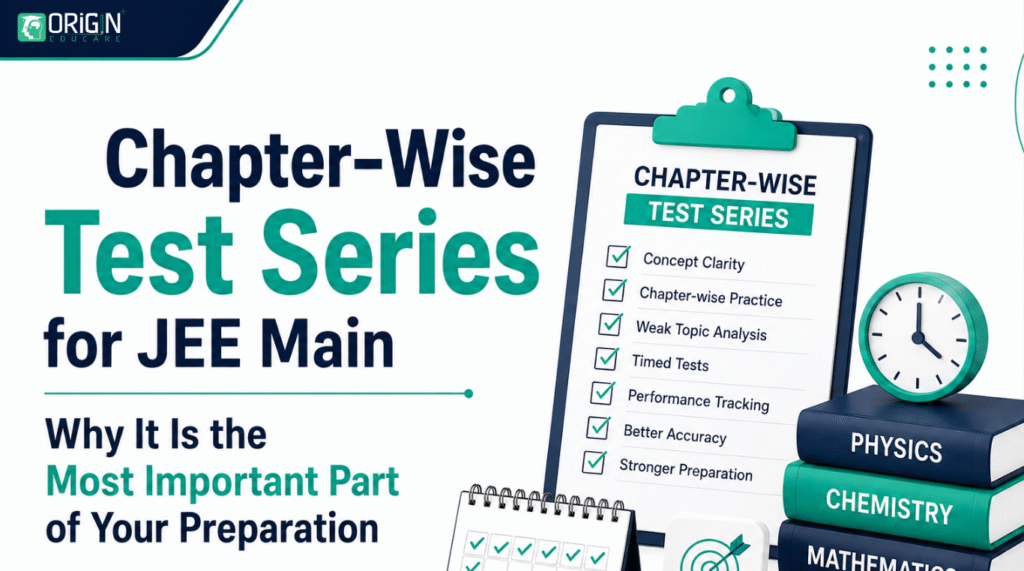
Most JEE aspirants prepare for months — and still walk into the exam unprepared.
Not because they did not study. Because they never tested what they studied chapter by chapter while it was still fresh.
A chapter-wise test series for JEE Main is not a supplementary tool. For serious JEE aspirants, it is the core of effective preparation.
In this blog, we explain what chapter-wise tests are, why they beat full mock tests for targeted preparation, how to use them correctly, and how our test series at Origin Educare is built to identify gaps and fix them fast.
A chapter-wise test series is a structured set of short tests, each covering one chapter, taken immediately after completing that chapter during JEE preparation.
Unlike a full-length JEE Main mock test, which covers all three subjects and all chapters, a chapter-wise test isolates one topic at a time. It tells you exactly how well you understood that specific chapter before you move forward.
Each chapter-wise test for JEE Main typically includes:
This is the most precise diagnostic tool available in JEE preparation.
Full-length mock tests are essential. But they are weak diagnostic tools when used alone.
Here is why.
In a full 300-mark mock test, a student can guess two numerical answers correctly in a weak chapter and never realise that chapter still needs serious work. The final score hides individual chapter weaknesses.
A chapter-wise test exposes exactly which chapter is weak and which specific question types within that chapter are the problem.
The four reasons chapter-wise tests are irreplaceable:
Not all chapters are equal. Some chapters are foundational — a gap in these costs marks across multiple future topics.
Physics — Test These Chapters First:
Chemistry — Test These Chapters First:
Mathematics — Test These Chapters First:
These chapters form the backbone of JEE Main. A weak score on any chapter-wise test here is a signal to stop, revise, and retest before moving forward.
Having a chapter-wise test series is not enough. Using it correctly is what produces results.
Rule 1: Test Within 48 Hours of Finishing the Chapter: Do not wait a week after completing a chapter to take its test. Test within 48 hours while concepts are still fully accessible. Testing a chapter you finished two weeks ago without revision measures memory decay, not actual understanding.
Rule 2: Treat Every Test Like the Real Exam: Set a timer. No notes. No open textbook. No calculator. Every chapter-wise test must simulate real JEE exam conditions; otherwise, the data it gives you is not accurate.
Rule 3: Analyse Every Wrong Answer Specifically: After every chapter-wise test — do not just look at your score. For every wrong answer, identify the exact error type:
Each error type needs a different correction approach.
Rule 4: Maintain an Error Notebook: Write every mistake from every chapter-wise test in a dedicated notebook with the correct approach next to it. Review this notebook before every subsequent test. Before JEE Main, this notebook becomes your most powerful last-minute revision tool.
Rule 5: Retest Weak Chapters Before Moving Forward: If you score below 65% on a chapter-wise test, do not move to the next chapter. Revise the weak chapter thoroughly and retest. Moving forward with a weak chapter is the single most common and most costly mistake in JEE preparation.

Before choosing any test series — check these five things.
JEE Main Pattern Alignment: Questions must match the actual JEE Main format: correct distribution of single correct, multiple correct, and integer-type questions. Tests using school exam format are not useful for JEE preparation.
Three Difficulty Levels Per Chapter: NCERT level, JEE Main level, and JEE Advanced level all three must be present. This identifies exactly where your understanding breaks down, from basic application to greatest difficulty.
Detailed Performance Report: A score alone is useless. You need accuracy per question type, time spent per question, topic-level weak areas, and a clear action plan for what to study next.
IITian-Built Questions: Questions built by IITians who have cracked JEE are calibrated to match the traps, the approach, and the difficulty curve that you will face on exam day. Generic question banks do not.
Re-attempt Facility: You must be able to re-attempt any chapter test after revision to verify that your understanding actually improved, not just moved on.
At Origin Educare, our chapter-wise test series for JEE Main is built by IITian faculty from Kota — designed to identify gaps precisely and help students fix them before they compound.
What our test series includes:
Our test series aligns with the latest JEE Main and JEE Advanced exam patterns.
Explore our JEE Main Test Series and JEE Advanced Test Series in detail.
Virash Sir, IIT Bombay, leads Mathematics. His students who used this exact testing system have achieved AIR 25, AIR 35, AIR 96, and AIR 174 in JEE Advanced.
Our chapter-wise test series is included in all JEE coaching programs:
Check our scholarship programme for fee concessions. Book a free demo class to experience our teaching and testing system today.
A chapter-wise test series for JEE Main is not an add-on. It is not something you do when you have extra time.
It is the mechanism by which you convert studying into understanding — and understanding into marks.
Study a chapter. Test within 48 hours. Analyse deeply. Fix what is weak. Retest. Move forward only when ready.
This cycle repeated across every chapter is what separates students who walk into JEE Main confident from those who walk in hoping.
Start testing from Chapter 1. Every chapter. Every time.
👉 Visit origineducare.com — Explore our JEE Main Test Series and book a free demo class today.
A chapter-wise test covers only one chapter: 15 to 25 questions in 20 to 45 minutes. A full JEE Main mock test covers all three subjects and all chapters: 90 questions in 3 hours. Chapter-wise tests are precise diagnostic tools used chapter by chapter throughout preparation. Full mock tests are used in the final 2 to 3 months to build stamina and test overall readiness.
From the very first chapter immediately. Take the chapter-wise test within 48 hours of completing every chapter. Do not wait until you have studied multiple chapters. The sooner you test, the sooner you find gaps and the more time you have to fix them.
Target a minimum of 70% accuracy before moving to the next chapter. If you score below 65%, stop, revise the chapter thoroughly, and retest. Never move forward with a chapter test score below 65%. The gap will compound into every related chapter that follows.
Chapter-wise tests first, always. Begin chapter-wise tests from the very first chapter of your preparation. Start full-length mock tests only after covering 60 to 70% of the JEE Main syllabus, typically in the second half of Class 12 or the October-November phase of a dropper year.
One test per chapter minimum across Physics, Chemistry, and Mathematics. JEE Main covers approximately 60 to 70 chapters across all three subjects. That means a minimum of 60 to 70 chapter-wise tests plus part-syllabus tests and full mock tests. Quality platforms like Origin Educare include 20+ structured tests as part of every JEE program.
Test Series for JEE Droppers/Repeaters: A Different Strategy for a...
Read MoreChapter-Wise vs Full-Syllabus Test Series: Which One Should You Take...
Read More