
Test Series for JEE Droppers/Repeaters: A Different Strategy for a...
Read More

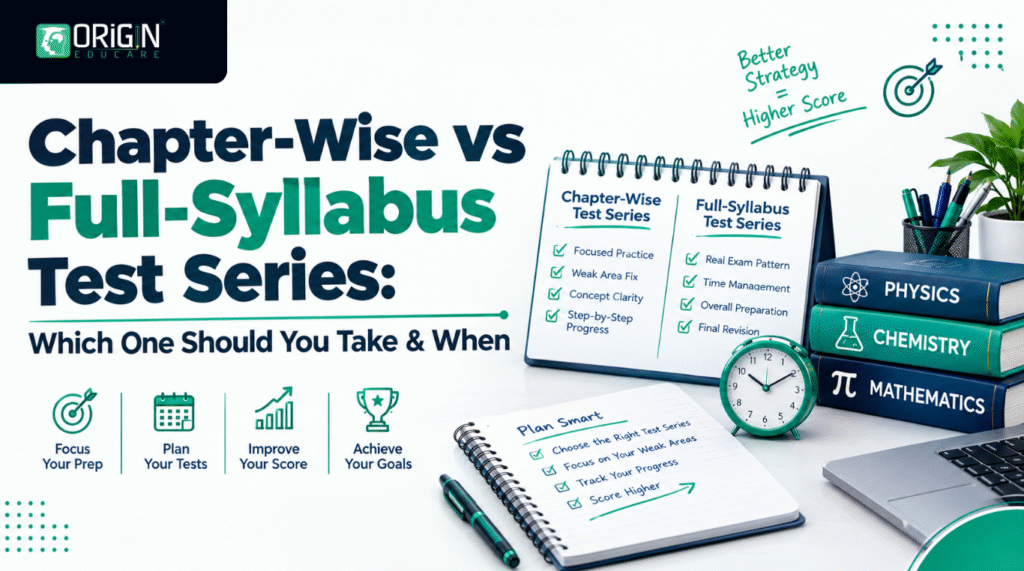
Every JEE aspirant faces this decision at some point.
Should I take chapter-wise tests or jump straight to full-length mock tests?
Most students make this decision based on what their friends are doing or what their coaching institute tells them without much explanation.
The result is almost always the same.
Students who start full mock tests too early score 80 to 120 out of 300, feel demoralised, and conclude they are not prepared enough. Students who stick only to chapter tests never build the stamina and pacing strategy that JEE Main demands.
Both are wrong approaches. Both are caused by the same mistake using the right tool at the wrong time.
This blog gives you the complete decision framework for when to use chapter-wise tests, when to use full-syllabus tests, and how to transition between them based on your exact preparation stage.
Think of JEE preparation as building a house.
Chapter-wise tests are the bricks: individual, precise, foundational. You lay them one by one. Each brick must be solid before the next one goes on top.
Full-syllabus mock tests are the stress test you apply full load to the entire structure to see if it holds. If you run the stress test before enough bricks are laid, the house collapses. You learn nothing useful except that it collapsed.
The correct sequence is always: lay bricks thoroughly → verify each section holds → then run the stress test on the whole structure.
In JEE terms: chapter tests first → part-syllabus cumulative tests → full mock tests.
But the exact timing of each transition depends on three factors — your class, your preparation stage, and the month you are in.
Most students know chapter tests and full mock tests. Very few use the third type — part-syllabus tests — correctly.
Test Type | What It Covers | Duration | Primary Purpose |
Chapter-wise test | 1 chapter (15–25 questions) | 20–45 minutes | Identify conceptual gaps in real time |
Part-syllabus test | 3–6 chapters (1 or 2 subjects) | 45–90 minutes | Test cumulative retention and topic-switching |
Full-syllabus mock test | All chapters, all subjects | 3 hours (180 minutes) | Build exam stamina, pacing, and question selection |
All three are essential. None of them replaces the others. The question is not which one to use it is which one to use now, at your current stage.
Use: Chapter-wise tests only
At this stage, you have not covered the full syllabus yet. Full mock tests at this stage produce low, discouraging scores without useful diagnostic data.
A student who has studied 20 chapters scoring 90 out of 300 on a full mock test learns nothing specific. They only feel bad. A student taking chapter-wise tests after every chapter knows exactly which of those 20 chapters has a gap and fixes it immediately.
Rule: Take every chapter-wise test within 48 hours of completing that chapter. Do not skip any chapter regardless of how confident you feel.
Minimum acceptable score before moving forward: 65% accuracy on JEE Main-level questions.
Use: Part-syllabus tests
Once you have completed 4 to 6 chapters, introduce part-syllabus tests.
Part-syllabus tests serve a purpose that chapter tests cannot: they test whether you can identify which chapter a problem belongs to without being told. In JEE Main questions are not labelled by chapter. You must rapidly assess what type of problem you are facing and switch approaches accordingly.
Part-syllabus tests build this skill.
Rule: Take one part-syllabus test after every 4 to 6 chapters per subject. Score below 60%? Go back and retest the weakest chapters individually before the next part-syllabus test.
Use: Chapter tests + Part-syllabus tests + First full mock tests
Once 60 to 70% of the JEE Main syllabus is covered and tested at chapter level — begin full-length mock tests.
Not instead of chapter tests alongside them.
Continue taking chapter tests for newly completed chapters. Continue part-syllabus tests every few chapters. Add 1 full mock test per week on top of this.
Why now and not earlier?
A full mock test with 70% syllabus coverage gives you useful feedback on both what you know and what you do not. A full mock test with 30% coverage only tells you that you have not covered 70% of the syllabus, which you already knew.
Use: Full mock tests (primary) + Weak chapter retests
Now full mock tests dominate.
Take 2 to 3 full mock tests per week. Analyse every test in detail the same day. For every chapter where you scored below 60% in the mock go back to the chapter test for that chapter and retest.
This is the only way to prevent old gaps from reappearing on exam day.
Chapter tests at this stage are not for new learning. They are for plugging holes that mock tests reveal.
Not all students are at the same stage at the same time. Here is a precise guide based on your situation.
Student Type | Now (Aug 2026) | Recommended Test Type | Full Mocks Begin |
Class 11 — started in June | 3 months in | Chapter tests only | February 2027 |
Class 12 — starting fresh | Month 1 | Chapter tests + part-syllabus tests | November 2026 |
Class 12 — mid-preparation | 4–6 months in | All three types | Immediately |
Dropper — weak chapters identified | Day 1 | Targeted chapter tests first | October 2026 |
Dropper — full syllabus covered | Revision phase | Full mocks (3/week) + weak chapter retests | Immediately |

Understanding the framework is not enough. Most students know they should use chapter tests before full mocks but still make these mistakes.
Mistake 1: Starting Full Mocks Too Early: Students feel peer pressure when their friends start full mock tests in July or August. They join in, score low, and lose momentum.
Fix: Ignore what others are doing. Follow the stage-based framework above. Your mock test start date depends on your syllabus coverage, not on the calendar.
Mistake 2: Skipping Chapter Tests for “Easy” Chapters: Students test themselves on chapters they feel weak in but skip tests for chapters they feel confident about. This leaves hidden gaps that surface in full mocks.
Fix: Test every chapter. Especially the ones you feel confident about. Confidence from studying is not the same as performance under timed pressure.
Mistake 3: Not Analysing Chapter Tests: Students take chapter tests and check their score. They don’t analyse why they got answers wrong; they just move on.
Fix: Spend as much time analysing a chapter test as you spent taking it. Every wrong answer contains specific diagnostic information. A score without analysis is useless.
Mistake 4: Stopping Chapter Tests Once Full Mocks Begin: Students switch entirely to full mock tests and abandon chapter-level testing. When full mock scores plateau, they have no way to identify which specific chapters are responsible.
Fix: Continue chapter-level retests for weak chapters throughout the full mock phase. Chapter tests and full mock tests run in parallel — they do not replace each other.
This schedule applies to students targeting JEE Main January 2027.
Month | Chapter Tests | Part-Syllabus Tests | Full Mock Tests |
August 2026 | After every chapter | Every 4–6 chapters | None |
September 2026 | After every chapter | Every 4–6 chapters | None |
October 2026 | For new chapters + weak ones | Every 4–6 chapters | 1 per week |
November 2026 | Weak chapters only | Monthly revision | 2 per week |
December 2026 | Weak chapters only | None | 3 per week |
January 2026 (pre-exam) | Stop — revision only | None | 1 per day (final week) |
At Origin Educare, our test series for JEE Main and Advanced is built around exactly this three-type framework — chapter tests, part-syllabus tests, and full-length mocks — each available at the right stage of preparation.
Every chapter test in our series includes questions at three difficulty levels — NCERT, JEE Main, and JEE Advanced. Every test produces a detailed performance report — not just a score. Re-attempt is available after revision to track genuine improvement.
Our full-length mock tests are aligned to the latest JEE Main exam pattern and JEE Advanced exam pattern.
Virash Sir — IIT Bombay — leads Mathematics. Students using our testing system have achieved AIR 25, AIR 35, AIR 96, AIR 174, and AIR 577 in JEE Advanced.
Our test series is included in all JEE programs:
Book a free demo class today. Check our scholarship programme.
Chapter-wise tests and full-syllabus tests are not competitors. They are partners.
Chapter tests build the foundation chapter by chapter, concept by concept. Part-syllabus tests verify cumulative retention. Full mock tests stress-test the complete structure under real exam conditions.
The decision of which one to use is not about preference. It is about stage.
Identify your stage. Choose the right tool. Use it correctly. Transition at the right time.
This is the testing framework that turns JEE preparation into JEE performance.
👉 Visit origineducare.com. Explore our JEE Test Series and book a free demo class today.
Switch to full mock tests when you have covered and tested at least 60 to 70% of the JEE Main syllabus at chapter level. Before this threshold — full mock tests produce discouraging scores without useful diagnostic information. After this threshold — full mock tests give actionable feedback on both strengths and remaining gaps. For most Class 12 students — this transition happens in October or November.
Yes — and you should. Once full mock tests begin, continue chapter-wise tests for newly completed chapters and for any chapter where mock test performance indicates a gap. They serve different purposes and run in parallel — chapter tests diagnose specific gaps, full mocks test overall exam readiness. One does not replace the other.
A part-syllabus test covers 4 to 6 recently completed chapters across one or two subjects. It tests two skills that chapter tests cannot: cumulative retention across related topics, and the ability to identify which chapter a problem belongs to without being told. JEE Main does not label questions by chapter — part-syllabus tests build the topic-switching speed that the real exam demands.
Stop taking full mock tests temporarily. Return to chapter-level testing on the specific subjects or chapters where mock test performance is weakest. Run the targeted chapter testing protocol for 2 weeks. Then resume full mock tests. Continuing to take full mocks when specific chapter gaps are unaddressed produces the same discouraging score repeatedly — without improvement.
A minimum of 30 to 40 full-length mock tests before JEE Main January session — spread across October to January. Quality of analysis matters more than quantity of tests. One well-analysed mock test that leads to specific chapter corrections is worth more than five mock tests taken without review. Always analyse the same day — do not move to the next test before fixing the previous one’s mistakes.
Test Series for JEE Droppers/Repeaters: A Different Strategy for a...
Read MoreChapter-Wise vs Full-Syllabus Test Series: Which One Should You Take...
Read More