
Test Series for JEE Droppers/Repeaters: A Different Strategy for a...
Read More

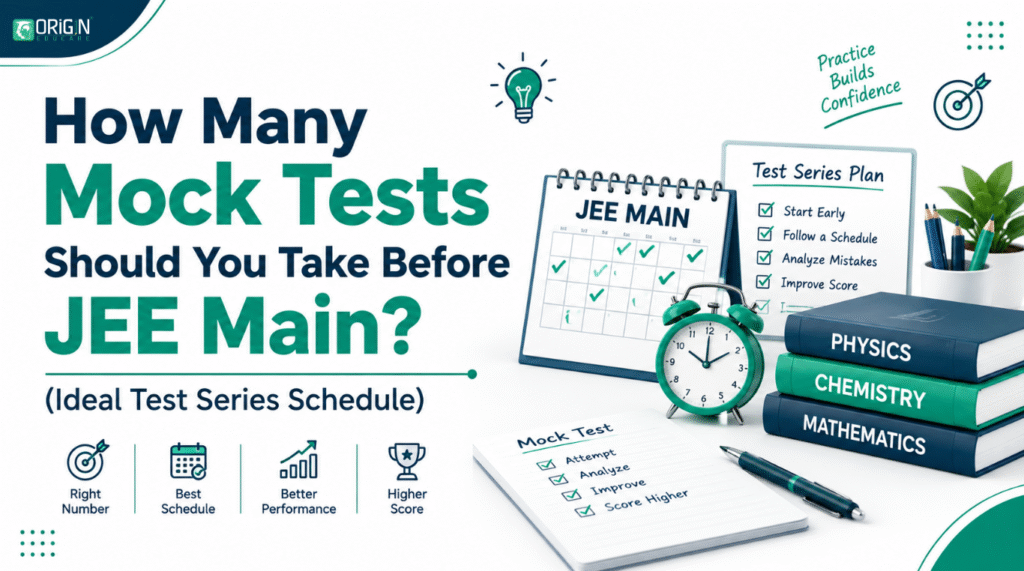
It’s 11 PM, you’re scrolling a JEE forum, and one student says they gave 40 mocks while another swears 12 was enough. Now you’re more confused than before you searched. Here’s the honest answer: there is no single magic number — but there is a range that works for almost every serious aspirant, and a schedule that matters far more than the total count.
For most JEE Main 2027 aspirants, the sweet spot is 20 to 40 full-length mock tests spread across the final 3–4 months before the exam, layered on top of regular chapter-wise and part-syllabus tests taken throughout the year. Let’s break down exactly how to structure that.
Two students can take the exact same 30 mocks and land on completely different scores. The difference isn’t luck — it’s what happens after each test. A mock test does three jobs, and only one of them is telling you your score:
Taking 40 mocks without reviewing a single one teaches you almost nothing. Taking 15 mocks with deep analysis after each one will move your score more than double the tests taken carelessly.
Before planning your test count, know your exact target. As per NTA’s official notice, JEE Main 2027 Session 1 will be held on January 22, 23, 24, 28, 29, and 30, 2027, with January 31 kept as a buffer date. Session 2 (April 2027) will be announced separately, and your better score across both sessions counts for your final rank.
Exam detail | Specification |
Mode | Computer-Based Test (CBT) |
Duration | 3 hours |
Total questions | 75 (25 per subject: 20 MCQs + 5 numerical) |
Maximum marks | 300 |
Marking | +4 for correct, −1 for incorrect MCQs |
Shifts | 9 AM–12 PM or 3 PM–6 PM |
Every mock you take should replicate this exact structure: same question count, same timing, same negative marking; otherwise, you’re practicing a different exam than the one you’ll actually sit for.
Rather than chasing one number, follow a phase-wise build-up. This is how most experienced mentors and recent test-series strategies structure it:
Skip full-length mocks entirely at this stage — your syllabus isn’t ready, and a full mock will only confirm gaps you already know exist, which can dent confidence for no real gain.
Focus instead on:
This is when full-length mocks should begin — not before. Starting too early, before your syllabus is substantially covered, measures gaps rather than readiness.
Frequency increases as concepts solidify and only revision + speed-building remain.
By the time Session 1 arrives, most students following this build-up have completed somewhere between 20 and 40 full-length mocks, plus many more chapter-wise and part tests taken throughout the year. Students repeating the exam (droppers) or those with a longer runway sometimes push toward the higher end of this range, closer to 40–50, since they have more preparation months to distribute tests across.
It’s tempting to think more mocks automatically means a better rank, but this backfires in three common ways:
The right question isn’t “how many mocks have I taken”; it’s “how many mocks have I actually learned something from.”

A test series only works if the review process is as disciplined as the test itself. After every mock:
Origin Educare’s Online Test Series for JEE is built around exactly this phase-wise approach rather than a flat, one-size-fits-all test calendar:
This structure means students aren’t left wondering whether they’ve taken “enough” tests; the schedule is built to match where they actually are in their preparation.
There’s no universal magic number for JEE Main mock tests, but 20 to 40 full-length mocks in your final 3–4 months, layered on a full year of chapter-wise and part tests, is a realistic and proven range. What separates a good rank from a stagnant one isn’t the test count on a tracker; it’s whether you analyse every test, understand it, and act on it before the next one begins.
Yes, generally. Full-length mocks measure exam-day readiness, and taking them before your syllabus is substantially covered mostly just confirms gaps you already know about. Chapter-wise and part tests are better suited to that earlier stage.
Droppers often have a longer preparation runway and a stronger conceptual base by the start of their second attempt, so they can reasonably aim toward the higher end of the range, around 30 to 50 full-length mocks spread out to avoid burnout.
Neither extreme is ideal. Consistency in difficulty level matters more, since it lets you compare scores meaningfully across weeks. A mix that reflects the actual JEE Main difficulty distribution is more useful than either very easy or very hard mocks.
It’s usually better not to. Use the final day before an exam date for revising your error log and staying calm rather than sitting through another 3-hour test.
No that range refers specifically to full-length mocks. Chapter-wise and part tests are additional and are typically taken far more frequently throughout the year, especially in Class 11 and early Class 12.
Test Series for JEE Droppers/Repeaters: A Different Strategy for a...
Read MoreChapter-Wise vs Full-Syllabus Test Series: Which One Should You Take...
Read More