
Test Series for JEE Droppers/Repeaters: A Different Strategy for a...
Read More

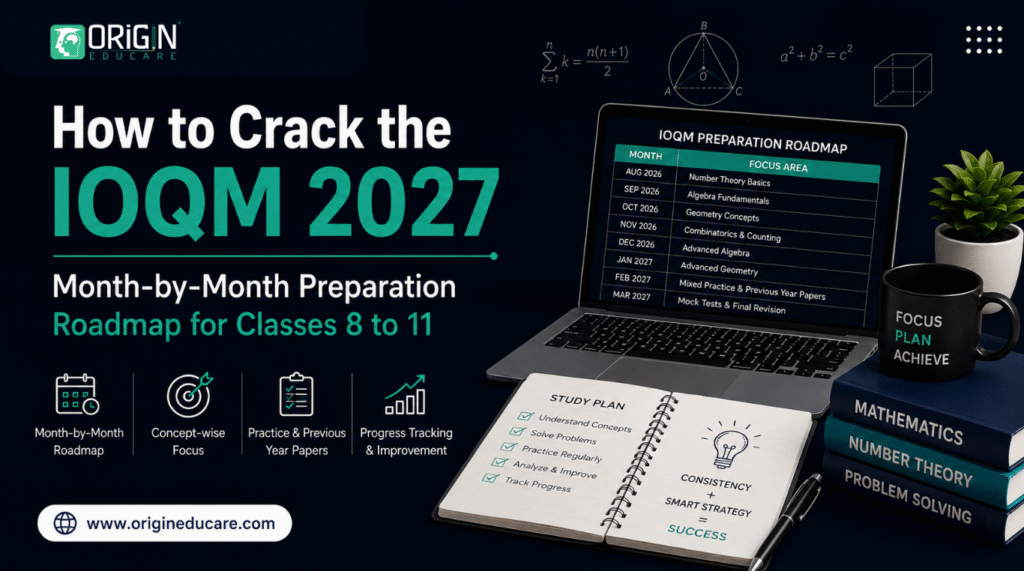
IOQM 2026 just happened or is happening right now.
If you are reading this after the exam, this blog is for you.
Because IOQM 2027 preparation starts today. Not next month. Not after results. Today.
The students who crack IOQM 2027 with strong scores are not the most naturally gifted mathematicians. They are the most consistently prepared ones. They start early. They build the right foundations. They practice the right problems month by month without rushing.
In this blog, we give you a complete month-by-month roadmap to crack IOQM 2027 for students in Class 8, 9, 10, and 11.
IOQM stands for Indian Olympiad Qualifier in Mathematics.
It is conducted by HBCSE the Homi Bhabha Centre for Science Education, and is the first stage of India’s Mathematical Olympiad program. Clearing IOQM qualifies you for RMO (Regional Mathematical Olympiad), then INMO, and eventually the International Mathematical Olympiad (IMO).
IOQM is a 3-hour exam with 30 integer-answer questions. No multiple choice. No negative marking. Answers are integers from 00 to 99.
The four core areas tested are:
The same syllabus applies to every class from Class 8 to Class 12. But the earlier you start, the more time you have to build genuine mathematical depth.
This is the most important thing to understand before you begin.
IOQM does not test what you know. It tests how you think.
School mathematics is about applying formulas correctly. IOQM mathematics is about building original solutions to problems you have never seen before. Questions are non-routine. There is no fixed method to follow. You must reason from first principles every time.
This is why students who start preparing for IOQM in Class 8 or 9 have a massive advantage. They have 2 to 3 years to develop mathematical thinking slowly, deeply, without pressure.
Students who start in Class 11 can still crack IOQM, but they need to be extremely focused and structured in a shorter timeframe.
IOQM 2027 will be held in September 2027. Starting August 2026, you have approximately 12 to 13 months.
Here is how to use them.
This is the most important phase of your entire IOQM preparation.
Do not rush to advanced Olympiad problems. Build the language of mathematics first.
What to study:
How to study: Do not memorise solutions. Understand every step. Ask yourself “Why does this work?” For every theorem, prove it yourself before moving forward.
Start a mistake notebook: write every problem you got wrong, why you got it wrong, and the correct approach. This notebook will be your most valuable revision tool before the exam.
Time commitment: 1.5 to 2 hours per day.
Now that your school foundations are solid, begin Olympiad-specific problem solving.
Number Theory:
Algebra:
Geometry:
How to study: Solve topic-wise problems from Olympiad books. Do not attempt full papers yet. Focus on one topic per week. Solve 10 to 15 problems per topic correctly before moving forward.
Recommended resources:
Time commitment: 2 hours per day.
Combinatorics and advanced Number Theory are where most IOQM marks are decided and where most students are weakest.
Combinatorics:
Advanced Number Theory:
Advanced Algebra:
How to study: This phase requires slower, deeper work. Do not rush. One strong solution to a hard problem is worth more than 10 rushed attempts at easy ones.
Time commitment: 2 to 2.5 hours per day.
By March, you have covered all four topic areas. Now it is time to practice full IOQM and PRMO past papers.
What to do:
Target by end of May: Consistently attempting 18 to 22 questions per paper. Getting 12 to 15 correct.
Time commitment: 2 to 3 hours per day. One full paper every week.
By June, your conceptual preparation should be complete.
June and July are about building speed and reducing errors.
What to do:
Time commitment: 2 hours daily. Mock test every 2 weeks.
IOQM 2027 is approximately 4 to 5 weeks away.
What to do:
What not to do:
Time commitment: 2 hours daily. Revision only, no new content.
At Origin Educare, our Olympiad and Foundation Courses for Class 6 to 10 are designed to build exactly the kind of mathematical thinking IOQM demands.
Our faculty, including Virash Sir (IIT Bombay) for Mathematics, teach Olympiad preparation with the same depth and rigour that produces top JEE rankers like AIR 25, AIR 35, and AIR 96.
What our Olympiad program includes:
Explore our Foundation Course for Class 8, Class 9, Class 10, and Class 11 JEE coaching, all of which build the Olympiad-level mathematical thinking that IOQM demands.
Check our scholarship programme for fee concessions. Book a free demo class to experience our teaching before committing.

For official IOQM information, visit the HBCSE official website and the IOQM official portal.
IOQM 2027 is 12 months away.
That is enough time if you start today.
Build foundations in August and September. Go deep into topics from October to February. Solve past papers from March to July. Sharpen speed in August.
One problem solved correctly today is better than ten problems rushed through tomorrow.
Start now. Build slowly. Improve consistently.
👉 Visit origineducare.com. Explore our Foundation and Olympiad courses and book a free demo class today.
With consistent daily study of 1.5 to 2 hours, 10 to 12 months is sufficient for most students. Students in Class 8 or 9 who start now have a full year, which is ideal. Class 11 students starting now need to be more intensive 2 to 3 hours daily to cover the syllabus thoroughly in time.
No. The IOQM syllabus is the same for every eligible class, from Class 8 to Class 12. There is no separate class-wise syllabus. The four core areas Number Theory, Algebra, Geometry, and Combinatorics apply to every student equally.
Yes and Class 8 is actually the best time to start. Students who begin IOQM preparation in Class 8 develop strong mathematical reasoning over 2 to 3 years, which gives them a significant advantage. Many IOQM qualifiers begin their Olympiad journey in Class 7 or 8.
Number Theory and Geometry consistently carry the highest weightage in IOQM. Algebra and Combinatorics are equally important, and Combinatorics is where most students are weakest. Give special attention to modular arithmetic, divisibility, circle theorems, and counting principles.
Absolutely. IOQM trains students to think deeply, reason logically, and solve non-routine problems exactly the skills JEE Advanced demands. Students who crack IOQM consistently perform better in JEE Mathematics than peers who did not. Starting IOQM preparation in Class 8 to 10 builds a mathematical foundation that directly accelerates JEE preparation in Class 11 and 12.
Test Series for JEE Droppers/Repeaters: A Different Strategy for a...
Read MoreChapter-Wise vs Full-Syllabus Test Series: Which One Should You Take...
Read More